Privatizing NC’s Water, Undermining Justice (2011)
Executive Summary
By Katie Hicks, Hope Taylor, Siying Zhang and Mary Grant
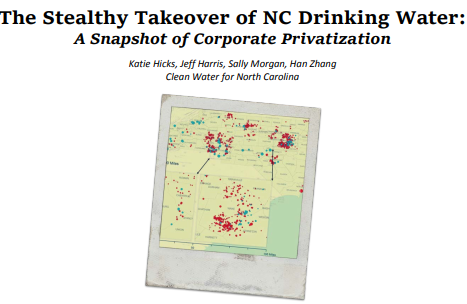
CWFNC documents the impacts of water privatization on communities across the state, describing the growing impacts private water and sewer companies are having on water affordability, customer service, and water quality.
Blue Ridge Paper: Still Toxic After All These Years (2007) Update (June 2007)
By Hope Taylor and Gracia O’Neill (CWFNC) and Anna Slagle and Seth Smith (CWEET)
The Pigeon River, which flows from Western NC into Tennessee, has suffered from paper mill pollution since 1908. In the last decade, officials have claimed that the Pigeon River is now “clean.” Our report investigates this myth, and the answers may surprise you.
A Fairly Watered State (2006)
By Alexa Chew, Jill D. Rios and the Staff of Clean Water for North Carolina
This report examines state water allocation policy through the case study of the drought-vulnerable Yadkin-Pee Dee river basin. The effects of the 1998-2002 drought make a strong case for increased “water accountability,” changed incentives and water rate structures, and adoption of use reduction and conservation strategies throughout NC.
Achieving Environmental Justice in North Carolina Public Participation Policies (2006)
By Huei-An Chu
Public participation is critical to achieving environmental justice, as many injustices neglected by policy-making can be noted and considered early in any decision-making. Public notice and participation requirements are mandated in various environmental laws, at both federal and state levels. Many compliance guidances, program and policy tools have also been developed to enhance public participation.
Unequal Water Justice? Well Contamination Among Diverse Communities (2004)
By Kelli Reed
In an effort to strengthen environmental justice regarding North Carolina’s drinking water, this study aims to compare the experiences of communities of varied socioeconomic and ethnic backgrounds when faced with groundwater contamination incidents. It concludes that the degree to which low income and minority residents are negatively impacted, combined with the lack of notification, and inferior efforts for the provision of a clean water supply represent significant environmental justice concerns.
Keeping the Promise…or Down the Drain? (2002)
A status report on the 30th anniversary of the Clean Water Act – how far have we come?
Chemical Security in North Carolina
An introduction to the policies and federal and state agencies dealing with chemical security and emergency planning. Learn about your Local Emergency Planning Committee (LPEC) and how to get involved.
A River in Jeopardy (2002)
By Brad Carpenter, Scott Jackson, and Hope Taylor
The Yadkin-Pee Dee River Basin has faced numerous problems, including population growth and sprawl, sediment, nutrient runoff, and toxic substances. This report examines the threats and makes recommendations for the basin.